GE: Fuel Cell Startup Could Spark a Revolution
时间:2014-07-30 13:52 作者:日 光
There’s more than oneway to get energy out of natural gas. For decades,
one of the most promising methods–and also most difficult to pull off–
has been the fuel cell.
A fuel cell works like a battery, using a simple chemical reaction to
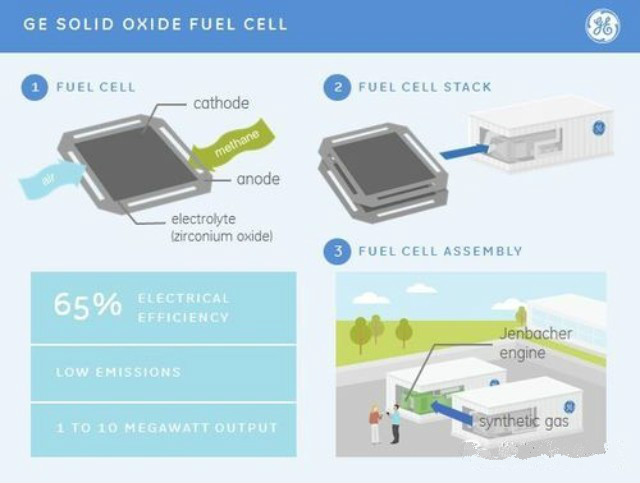
provide energy. In fuel cells, this reaction involves hydrogen molecules abundant in natural gas and oxygen from ordinary air. It sounds easy enough, but the process is full of pitfalls. Car companies, for example, have tried to make fuel cells work as a replacement for the internal combustion engine for more 20 years without commercial success. But scientists in GE (NYSE: GE) labs recently cracked an important conundrum involving one iteration of the technology called solid oxide fuel cell, or SOFC. The breakthrough allowed the company to start building a new pilot fuel cell manufacturing and development facility in upstate New York. The resulting technology could soon start producing electricity around the world. The new system’s power generation efficiency can reach an unprecedented 65 percent. Overall efficiency can grow to 95 percent when the system is configured to capture waste heat produced by the process. The basic configuration of the system can generate between 1 to 10 megawatts of power. Unlike other systems, the new fuel cell is using stainless steel in place of platinum and rare metals. "The cost challenges associated with the technology have stumped a lot of people for a long time," says Johanna Wellington, advanced technology leader at GE Global Research and the head of GE’s fuel cell business. "But we made it work, and we made it work economically. It’s a game-changer." Wellington says that the fuel cell, which received financial backing from GE’s ecomagination program, can generate electricity at any location with a supply of natural gas. It can get going quickly, does not need new transmission lines and produces lower emissions than conventional power plants. The fuel cell has no moving parts. The guts of the cell look like a stack of cookies. Each cookie is a metallic plate with a maze of flow channels cut into the bottom and a square of black "icing" on top. 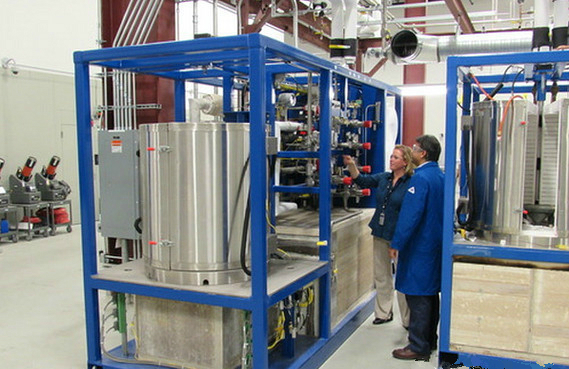
That icing is the core of the breakthrough that makes the solid oxide fuel
cell work. It contains three layers made from special ceramic materials: the cathode on top, the anode on the bottom, and a dense layer of solid oxide electrolyte in the middle. GE is using additive thermal spray technology originally developed to protect parts working inside jet engines to deposit the anode and the electrolyte. The cathode is screen-printed on the tile. "GE Global Research is the intellectual horsepower behind this technology," says GE materials scientist Kristen Brosnan. "Our materials are easy to apply, can handle large temperature swings and last a long time." The system generates electricity by feeding hydrogen-rich fuel heated to 1,500 degrees Fahrenheit through the channels cut under the anode.Equally hot air travels over the cathode. An electrochemical reaction mediated by the solid electrolyte between the hydrogen in the fuel and the oxygen in the air generates electricity, water, heat and synthetic gas, or syngas. This syngas, which contains residual hydrogen, still holds enough energy for more power generation. Wellington’s team feeds the syngas to Jenbacher engine attached to the fuel cell to generate additional electricity, bringing the electrical efficiency to 65 percent. The fuel cell business grew out of GE Global Research, but it now operates as an independent unit with its own board of directors. GE is building a new pilot development and manufacturing facility near Saratoga Springs, NY, that will be manufacturing the cells. The pilot facility is already filling up with robotic thermal spray equipment, fuel cell test stations, screen printers and towering bulk gas storage tanks. Wellington runs her pilot facility with a startup mentality. "We have all of the speed, agility and focus of a small start-up while leveraging the strength of a big company" she says. 来源:cbcu (责任编辑:admin) |